3 daysNorthwest coast (Palm Beach, Eagle Beach), Arikok National Park interior, Oranjestad

Two flagship beaches, the Natural Pool, and Oranjestad in one tight, honest plan

3 Days in Aruba: The First-Timer's Itinerary

Beaches, the Natural Pool, and Oranjestad, done right in three days

Days3
Best seasonYear-round (dry season February-March is most reliable; September-October offers the best hotel value if you don't mind brief rain showers)
PaceEasy
Duration
3 days
Region
Northwest coast (Palm Beach, Eagle Beach), Arikok National Park interior, Oranjestad
Best season
Year-round (dry season February-March is most reliable; September-October offers the best hotel value if you don't mind brief rain showers)
Budget pp
$280–$420
Airports
AUA
The route

Route overview

Three days is a tight but workable window for a first trip to Aruba, enough to hit the two beaches everyone asks about, get properly off the resort strip into Arikok National Park, and still snorkel and see Oranjestad before you fly home. This plan doesn't try to cram in everything the island offers. It picks one strong anchor per day and builds around it, so you're not spending half your trip in transit.

Day one settles you in and lets you compare Palm Beach against Eagle Beach directly, rather than picking one sight unseen. Day two trades sand for Aruba's wilder, hotter interior at Arikok and the Natural Pool. Day three closes with snorkeling, a walk through Oranjestad, and a last sunset dinner. If three days leaves you wanting more, our 5-day and 7-day itineraries pick up from here.

Trip highlights
  • Compare Aruba's two flagship beaches, Palm Beach and Eagle Beach, on your very first afternoon
  • Ride a guided jeep or UTV-to-jeep tour into Arikok National Park to reach the volcanic-rock Natural Pool
  • See Arawak ceiling paintings in Fontein Cave and the sunlit dome chambers of Quadirikiri Cave
  • Snorkel the calm northwest coves of Boca Catalina and Tres Trapi, a cove beloved for sea turtle encounters
  • Walk historic Oranjestad, from 1798 Fort Zoutman to the free solar streetcar, before a farewell sunset dinner
Day by day

The itinerary

01
Day 1

Arrival and the Two Flagship Beaches

Palm Beach and Eagle Beach Overnight: Palm Beach or Eagle Beach
Morning

Land at Queen Beatrix International (AUA) and head straight for your hotel strip. Aruba's taxis run on fixed, government-set fares rather than meters, so there's no guesswork: as of 2026 the flat rate from the airport to the Palm Beach high-rise area is $41 USD for up to four passengers, and $26 to Oranjestad. If you're staying along Palm Beach or Eagle Beach, skip the rental car on day one entirely, since you won't need it for a beach-only day. Check in, change, and get sand under your feet before you do anything else. Prices across the island, from bus fares to taxi rates, are posted in both US dollars and Aruban florin, so there's no currency scramble to slow you down.

Afternoon

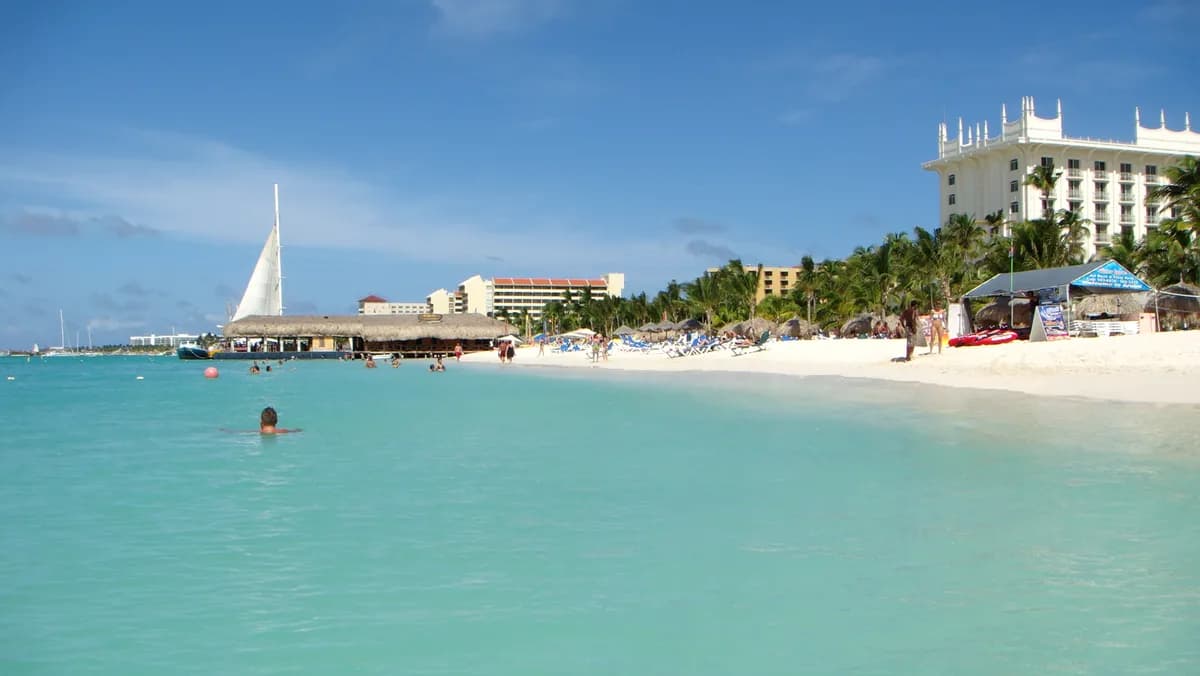
Spend the afternoon comparing the island's two signature beaches rather than committing to just one. Palm Beach has calm, shallow water that's reliably flat, plus watersports concessions and piers right off the sand, a comfortable choice if you'd rather not think about currents on your first afternoon. A short bus ride or roughly a 45-minute walk south along the coast gets you to Eagle Beach, the widest beach on the island, where loungers and palapas spread out instead of stacking in. Look for the leaning fofoti trees near the shore, gnarled, broad-leafed trees that tilt permanently southwest from the constant northeast trade winds; they're often mistaken for the divi-divi that grows all over the island. Every beach in Aruba is public except two privately owned islands (Renaissance Island and De Palm Island), and by law the first 10 meters inland from the shoreline is public property, so you're free to walk between resort frontages without a room key.

Evening

Stay put for sunset. Both beaches sit on Aruba's calm leeward coast, so the sun drops straight into the sea from wherever you're sitting. For dinner, The Chophouse at Manchebo and Screaming Eagle anchor the Eagle Beach side if you want a quieter, toes-in-the-sand kind of night, while Sunset Grille or The Vue Rooftop put you in the middle of the Palm Beach evening scene, walkable from most high-rise hotels. Either way, keep it an early night; tomorrow starts earlier and runs hotter.

Meals

Lunch casual near your hotel; dinner at The Chophouse at Manchebo or Screaming Eagle (Eagle Beach) or Sunset Grille (Palm Beach)

Transport

Fixed-rate taxi from AUA airport to your hotel; Arubus L10A bus connects Eagle Beach and Palm Beach in about 6 minutes if you want to see both without a car

Budget

~$75 per person

Local tip

Don't rent a car for day one. Between the fixed-fare airport taxi and the L10A bus running the hotel strip every 15 to 20 minutes on weekdays, you can cover this plan without one, and many Arikok tour operators include hotel pickup for day two.

02
Day 2

Arikok National Park and the Natural Pool

Arikok National Park, Santa Cruz Overnight: Palm Beach or Eagle Beach
Morning

This is the day to see the side of Aruba the resort strip never shows you. Arikok National Park covers nearly a fifth of the island: cactus desert, rugged hills, and a windward coastline where heavy surf pounds raw rock. A standard rental car cannot reach the Natural Pool (Conchi), the swimming hole ringed by volcanic rock that's the day's main event, so book a guided jeep safari or UTV-to-jeep tour in advance, or take the slower, quieter route with a horseback riding tour through the dunes that includes a swim stop at the pool. Going independently, buy your Conservation Pass ($22 per adult as of 2026, free for children under 17) at the San Fuego visitor center near Santa Cruz; that gate admits visitors 8:00am to 3:30pm. Go early either way, since the heat builds fast and the exposed trails and roads offer almost no shade.

Afternoon

Be honest with yourself about Conchi before you get there: swimming is entirely condition-dependent, and on rough-surf days rangers advise against getting in at all, so treat the pool as a bonus rather than the guaranteed centerpiece. Most guided tours bundle snorkel gear and a cave stop: Fontein Cave holds brownish-red pictographs painted on its ceiling by the Arawak, and Quadirikiri Cave's two dome chambers are lit by sunlight pouring through holes in the roof. Windward beaches like Dos Playa and Andicuri Beach make dramatic photo stops, but strong undertow and unpredictable currents make swimming inadvisable on this coast, so save your swim for the pool or the leeward side. The terrain is rough and genuinely hot: wear sturdy shoes, carry more water than feels necessary, and don't push a hike here if anyone in your group isn't prepared for direct sun with no shade.

Evening

Head back toward the coast for a shower and a change of clothes before dinner. If the off-road day left you hungry for something substantial, Pelican Nest Seafood Grill or Fisherman's Hut on Palm Beach are solid, unfussy choices. Keep the evening low-key: today runs longer and hotter than day one, and day three starts early again for snorkeling.

Meals

Lunch often included on morning jeep/UTV tours; dinner at Pelican Nest Seafood Grill or Fisherman's Hut

Transport

Guided 4x4 or UTV-to-jeep tour required for the Natural Pool; a regular rental car can reach the main Arikok roads and caves but not Conchi itself

Budget

~$110 per person

Local tip

Confirm with your tour operator whether the $22 Conservation Pass is included in the tour price, since some bundle it and others don't. Bring at least a liter of water per person regardless.

03
Day 3

Snorkeling, Oranjestad, and a Farewell Sunset

Boca Catalina and Oranjestad Overnight: Departure day
Morning

Start early at Boca Catalina, a small, sheltered cove on the calm northwest coast where clear, shallow water sits over a reef full of fish. Snorkeling at Boca Catalina works well as a self-guided outing if you already have gear, or book a short guided stop if you don't. Nearby Tres Trapi, a small rocky cove named for the three steps down to the water, is the spot best known for sea turtle encounters. Wherever you swim, keep a respectful distance from any turtle you find: don't chase, touch, or block its path back to open water, and let it surface and move on its own terms.

Afternoon

Dry off and head into Oranjestad for the afternoon. Fort Zoutman, an 1798 Dutch fort with the Willem III Tower added in 1868, anchors the old town and is worth a walk-around even if you skip the museum inside. The Oranjestad streetcar is free and solar-powered, looping the city center roughly 10am to 4 or 5pm, though it doesn't run Sundays and its schedule shifts around cruise ship arrivals, so check the current timetable rather than assuming it'll be there when you want it. Browse Caya Betico Croes for shopping, and stop at Wilhelmina Park on the waterfront for shade and a breather.

Evening

Close the trip with a proper farewell dinner. Driftwood Restaurant and Taste My Aruba both put fresh seafood and a real sense of place ahead of resort-standard menus, and Oranjestad's harbor gives you one more west-facing sunset before you pack. If your flight is early the next morning, keep the night reasonably short: getting from anywhere in the hotel strip back to AUA is quick, but you don't want to be rushing it after a trip this good.

Meals

Casual lunch near the beach; farewell dinner at Driftwood Restaurant or Taste My Aruba in Oranjestad

Transport

Rental car or taxi to Boca Catalina; Arubus L10A or a short taxi into Oranjestad for the afternoon; paid Aruparking (license-plate based) if you self-drive downtown

Budget

~$95 per person

Local tip

Never touch or chase a sea turtle, even a curious one. Keep your distance, watch quietly, and let it decide when to move on.

Before you go

Planning tips

  • Skip the rental car on days one and three; the Arubus L10A bus covers Palm Beach, Eagle Beach, and Oranjestad every 15 to 20 minutes on weekdays.
  • Book your Arikok jeep or UTV-to-jeep tour in advance: a standard rental car cannot reach the Natural Pool, and park gates stop admitting visitors by mid-afternoon.
  • Carry more water than feels necessary on day two. Arikok's trails and roads have little to no shade, and the island's average highs run 85 to 90°F year-round.
  • Prices and fares across the island, from buses to taxis, are posted in both US dollars and Aruban florin, so there's no need to change money before you land.
  • Every beach in Aruba is public apart from two privately owned islands (Renaissance Island and De Palm Island); you can sit under any unoccupied public palapa, but bring your own beach chair since loungers are typically resort property.
  • Keep a respectful distance from sea turtles while snorkeling and from any roped-off nesting sites on the beach; never touch or chase one.
Good to know

Frequently asked questions

Is 3 days enough for a first trip to Aruba?

+
Three days is enough to cover Aruba's core: both flagship beaches, Arikok National Park and the Natural Pool, snorkeling with a chance at sea turtles, and a walk through Oranjestad. What it doesn't leave room for is San Nicolas and Baby Beach on the island's southeast end, or a slower pace on any single beach. If you have more time, our 5-day Aruba itinerary adds that breathing room; if you're building a longer Caribbean trip, see our 7-day Aruba itinerary at /itineraries/aruba-7-day-itinerary.

Do I need to rent a car for this itinerary?

+
No, not for the whole trip. Day one and the Oranjestad half of day three work fine on the Arubus L10A bus or a taxi. Day two, reaching the Natural Pool inside Arikok requires a guided 4x4 or UTV-to-jeep tour regardless of whether you have a rental car, since standard cars can't handle that terrain. A car adds flexibility but isn't required if you're comfortable booking tours and using the bus.

Is the Natural Pool always swimmable?

+
No. Swimming at Conchi is entirely condition-dependent, and on rough-surf days park rangers advise against getting in the water. The pool has even been closed outright by the Aruba Conservation Foundation after severe weather. Check with your tour operator or the ACF the morning of your visit, and treat the pool as a bonus rather than a guarantee. The caves and the drive itself are worth the trip even if the pool is closed that day.

Which beach should I actually stay on, Eagle Beach or Palm Beach?

+
Eagle Beach suits a quieter, honeymoon-style trip with more space per person and a wider stretch of sand; Palm Beach suits first-timers and families who want calm, shallow water and restaurants within walking distance. They're about 3 km apart, roughly 6 minutes by bus, so you can base yourself on one and visit the other, which is exactly what day one of this itinerary does.

What should I budget for food and activities on this trip?

+
Plan roughly $280 to $420 per person for 3 days, covering meals, the Arikok tour and Conservation Pass, snorkeling, local transport, and one sit-down dinner each night. That excludes flights and hotel. The low end matches the per-day estimates in this plan ($75, $110, and $95); choosing fine-dining every night or adding extra activities pushes you toward the top of the range.
Plan your trip

Ready to plan your own?

Explore our destinations, beaches, and travel guides to customise this route for your trip.