Aruba vs Curaçao: Which Island Should You Choose?
Aruba or Curaçao? Beaches, diving, weather normals, flights, arrival fees and taxes, towns and safety compared with official figures.
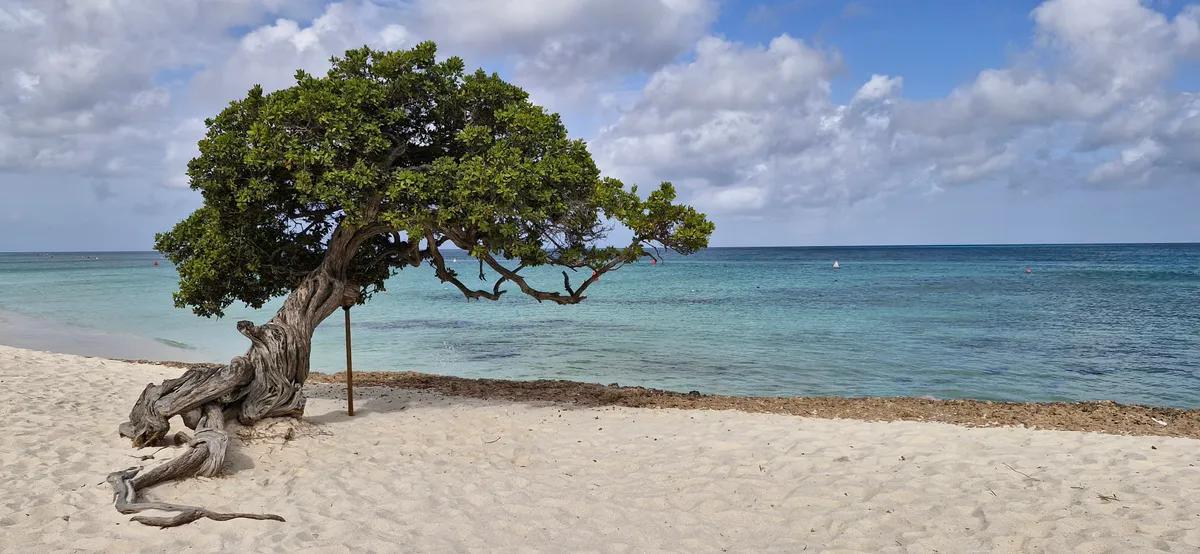
Choose Aruba for long white-sand beaches with free public access, a polished resort strip and the widest choice of flights from North America. Choose Curaçao for a UNESCO-listed capital, small coves with snorkeling and diving straight from the shore, and a more European, self-drive style of holiday. The climate is similar, and the US safety rating and the exchange rate are the same. The two islands are neighbours in the southern Caribbean and both are countries within the Kingdom of the Netherlands, but they attract different travellers. This comparison uses official figures, checked on 13 November 2026.
Aruba vs Curaçao at a Glance
| Aruba | Curaçao | |
|---|---|---|
| Size | 180 km² | 444 km² |
| Capital | Oranjestad | Willemstad |
| Stayover visitors, 2025 | 1,515,102 | 788,427 |
| Largest market | United States, about 72 percent | Netherlands 32.6 percent, United States 26.5 percent |
| Annual rainfall (1991 to 2020 normal) | 451 mm | 570 mm |
| Beaches | Long sandy strips; all mainland beaches are public | More than 35, mostly coves; some charge entry |
| Currency | Aruban florin, 1.79 per US$1 | Caribbean guilder, 1.79 per US$1 |
| US travel advisory | Level 1 | Level 1 |
Which Island Has Better Beaches?
For classic beach days, Aruba. Its west coast has the island's long stretches of pale sand and calm water. Palm Beach is a two-mile strip in front of the high-rise hotels, and Eagle Beach, wider and quieter with low-rise hotels behind it, placed fourth in the world in Tripadvisor's 2026 Best of the Best Beaches awards. The tourism authority states that every beach and cove on the island is public. Our Eagle Beach vs Palm Beach comparison helps you pick between the two.
Curaçao's beaches are a different kind of good. The tourist board counts more than 35, most of them small coves between limestone cliffs along the west coast. Several are run by private operators that charge a small entrance fee: Cas Abao displays US$6 per car of up to four people (US$7 on Sundays and holidays) and Porto Mari US$3 per person. Others are free. You reach them by car, and the reward is clear water with reef a short swim from the sand.
In short: Aruba if you want to walk out of the hotel onto a long beach, Curaçao if you like the idea of driving to a different cove each day.
Which Is Better for Snorkeling and Diving?
Curaçao has the edge. Its tourist board promotes more than 70 dive sites and a strong shore-diving culture: at many sites you wade in from the beach with no boat needed. One local operator displays a guided one-tank shore dive at US$70, with equipment rental extra. Snorkelers come for the same reefs, and for the green turtles that gather near the fishing pier at Playa Piskadó.
Aruba's signature dive is a wreck. The Antilla, a German freighter scuttled in 1940, is more than 350 feet long and lies in about 55 feet of water, shallow enough for snorkel tours to visit too. For reef snorkeling from shore, Boca Catalina and Mangel Halto are the best-known spots. See our Aruba snorkeling and diving guide for the rest.
Is the Weather Different?
Barely. Both islands are hot, windy and mostly dry, with a short rainy season late in the year, and both lie south of the tracks that most Atlantic hurricanes follow.
| 1991 to 2020 climate normals | Aruba | Curaçao |
|---|---|---|
| Annual rainfall | 451 mm | 570 mm |
| Wettest month | November, 87 mm | November, 141 mm |
| Average daily high, whole year | 31.8°C | 31.5°C |
| Average wind | 7.4 m/s | about 5.9 m/s |
Aruba is a little drier and noticeably windier, which keeps the heat comfortable and is why it draws windsurfers and kitesurfers. On both islands the wetter spell runs from October to December. Our best time to visit Aruba guide goes month by month.
Which Is Easier to Reach?
From the United States and Canada, Aruba has the wider choice, though it depends on your home airport. Its airport schedule for December 2026 lists flights from Miami, Charlotte, Philadelphia, Chicago, Dallas, Newark, Houston, Washington, Boston, New York JFK, Fort Lauderdale, Atlanta, Baltimore and Orlando, plus Toronto, Montréal and Ottawa. Aruba also has US preclearance: you pass US immigration and customs before boarding and land at home as a domestic passenger.
Curaçao has fewer North American routes. Its tourist board names Miami, Charlotte, Atlanta, New York JFK and Newark as nonstop US gateways, with Chicago added in December 2025. From Europe the picture reverses: the Netherlands is Curaçao's largest market, and a new Düsseldorf service is announced to start on 14 December 2026.
Which Is Cheaper?
There is no official price comparison, and we will not invent one. What can be compared are the fixed costs.
- Currency: a draw. Both currencies are pegged at 1.79 to the US dollar, and dollars are widely accepted on both islands.
- Arrival fees: Aruba charges visitors arriving by air a US$20 sustainability fee, paid online with the mandatory ED card (children under eight are among those exempt). Curaçao's Digital Immigration Card is free.
- Tax on rooms: Aruba's tourist levy on accommodation was raised to 12.5 percent in its 2023 tax reform. Curaçao taxes short stays at 7 percent.
- Beaches: Aruba's public beaches are free, apart from those inside Arikok National Park and on private islands; several of Curaçao's best charge a few dollars.
- National parks: Arikok in Aruba displays US$22 per adult; Christoffel Park in Curaçao US$15.
- Buses: Arubus displays US$2.60 for a single ride and US$15 for a day pass. Curaçao's public buses normally cost 2.00 to 2.50 guilders, a little over one US dollar.
One real figure for scale: Curaçao's tourist board reported an average hotel rate of US$273 a night for the first half of 2025. Aruba publishes no directly comparable number. Our Aruba on a budget guide shows how to keep costs down there.
What Is There Beyond the Beach?
Curaçao has the more memorable town. The historic centre and harbour of Willemstad have been a UNESCO World Heritage Site since 1997: rows of painted Dutch colonial merchant houses on both sides of a working harbour, joined by the floating Queen Emma Bridge of 1888. When the bridge swings open for ships, free ferries carry pedestrians across. Inland, Christoffel Park has the island's highest hill and its best hiking.
Aruba answers with landscape and events. Arikok National Park covers a large part of the island's rugged east, with the Natural Pool on its wild coast. San Nicolas has turned its streets into an open-air mural gallery. And Aruba's Carnival is one of the Caribbean's big ones: for 2027 the published schedule puts the Grand Parade in San Nicolas on 6 February and in Oranjestad on 7 February. See Aruba Carnival for the full season.
Where Will You Stay, and Do You Need a Car?
Aruba is built around two resort strips, the high-rise hotels of Palm Beach with their casinos and beach bars, and the low-rise hotels of Eagle Beach. Timeshare is a large part of the market: 26.5 percent of visitor nights in 2025, with all-inclusive stays at 12.9 percent. Because beaches, restaurants and shops cluster around Palm Beach, many visitors manage without a car and rent one for a day or two of exploring. Our where to stay guide covers each area.
Curaçao is more spread out. Visitors stay around Mambo Beach, Jan Thiel or the restored Pietermaai district of Willemstad, and the best beaches are roughly 30 to 60 minutes' drive to the west, depending on where you stay. A rental car for most of the stay makes a real difference. Visitors also stay longer: 8.4 nights on average in 2025, against roughly 6.8 in Aruba. Both islands drive on the right.
Is One Safer Than the Other?
Not on the official ratings. The US State Department rates both at Level 1, "Exercise Normal Precautions", its lowest advisory level (Aruba's notice was issued on 20 August 2026, Curaçao's on 9 September 2026). The UK Foreign Office mentions petty theft and street crime for both. Tap water is safe to drink on both islands; it is produced from seawater.
Can You Visit Both?
Yes. There is no ferry between the islands, so independent travellers fly. Divi Divi Air and Z Air operate the short hop between Aruba and Curaçao. Since both islands need their own online entry form, complete Aruba's ED card and Curaçao's Digital Immigration Card before you travel. A week in Aruba with three or four nights in Curaçao gives you both the beach holiday and the town.
So Which Should You Choose?
- Choose Aruba if you want the best walk-out beach, you are flying from the US or Canada, you prefer to stay in one resort area without driving, or you are travelling with young children who need calm, shallow water.
- Choose Curaçao if you dive or snorkel, you enjoy cities and architecture, you are happy to rent a car and explore, or you want a longer, slower trip.
Frequently Asked Questions
Is Aruba or Curaçao better for beaches?
Aruba, for long white-sand beaches with free public access. Curaçao has more than 35 smaller coves, better suited to snorkeling, and some charge an entrance fee.
Is Curaçao cheaper than Aruba?
No official comparison exists. Curaçao has a lower tax on accommodation (7 percent against 12.5 percent) and no arrival fee, while Aruba's main beaches are free and its hotels are concentrated in a pricier resort market.
Which island is bigger?
Curaçao, at 444 km², is about two and a half times the size of Aruba (180 km²).
Is there a ferry between Aruba and Curaçao?
No. Apart from cruises that call at both, the way to travel between them is a short flight.
Are Aruba and Curaçao in the hurricane belt?
Both lie south of the tracks most Atlantic hurricanes take, so direct hits are rare, though not impossible.
Do Aruba and Curaçao use the same currency?
No. Aruba uses the Aruban florin and Curaçao the Caribbean guilder, but both are fixed at 1.79 to the US dollar and US dollars are widely accepted.
Which is better for snorkeling?
Curaçao, thanks to reefs close to shore at many beaches. Aruba's highlights are the Antilla shipwreck and a few sheltered spots such as Boca Catalina.
About the author
Alex Borshch
Keep reading
Related articles
Get On The Newsletter Waitlist
The Aruba 365 newsletter has not launched yet. Leave your email to be told when it does. No mail app required.