Eagle Beach vs Palm Beach: Which Aruba Base Fits You
Quiet and wide or walkable and lively: here's the honest breakdown of Aruba's two flagship beaches, hotel by hotel and dollar by dollar.
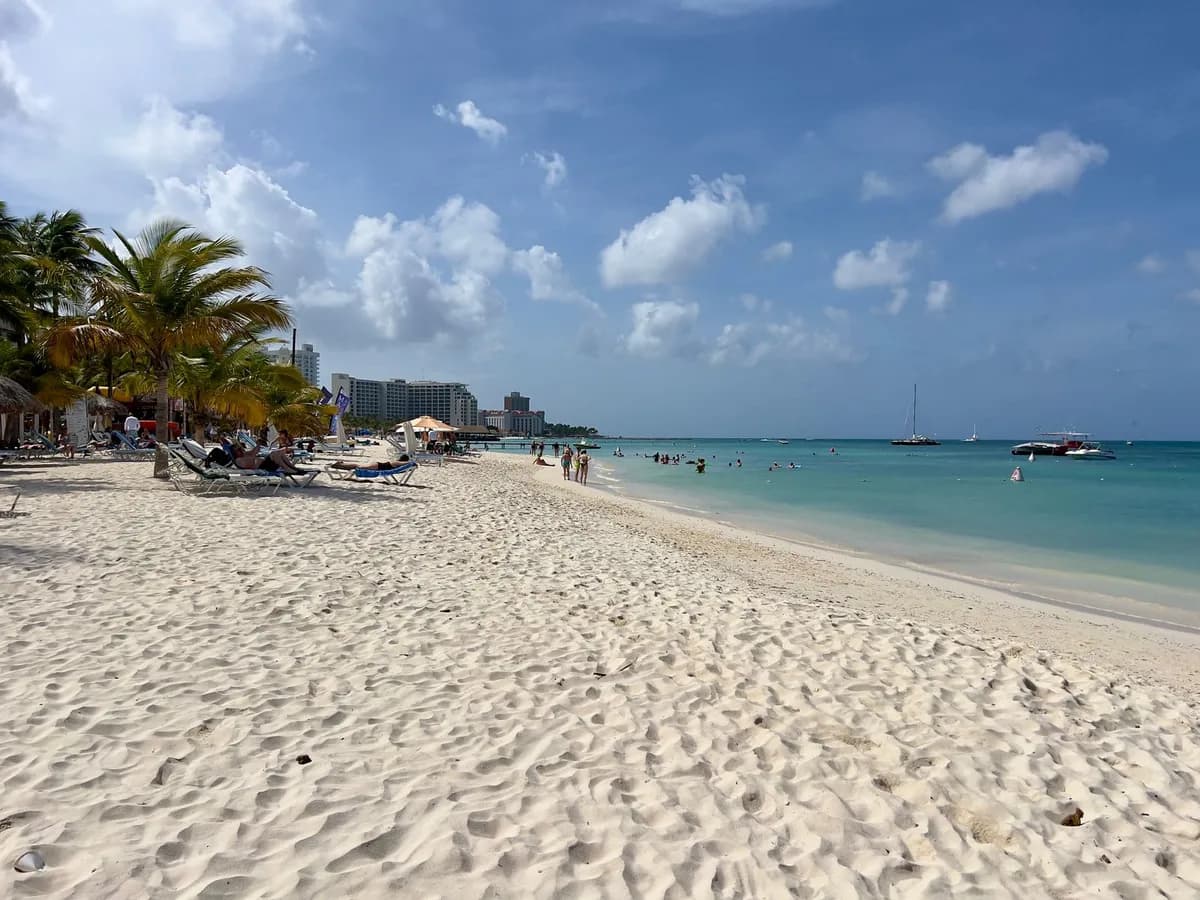
If you only have time to get one decision right before your Aruba trip, make it this one. Eagle Beach is the wide, quiet, low-rise strip of sand where the resorts top out at a few stories and the beach itself is the main event. Palm Beach is the two-mile stretch of high-rise hotels, casinos, and restaurants where you can walk out of your lobby straight into a full evening out. Neither is a wrong answer. The right one depends on whether you want a slow week or a full one.
Both beaches sit on the same stretch of Aruba's coast, about 3 km apart and roughly a 6-minute bus ride from each other. So this is less about which coastline to fly toward and more about what kind of base suits how you actually vacation. Choose Eagle Beach for space, quiet, and a honeymoon-friendly pace, accepting that you'll want a car or taxi for dinner variety. Choose Palm Beach for calm swimmable water, walkable restaurants and nightlife, and an easier trip if it's your first time on the island. The full comparison, including sand, water, hotels, and cost, follows below.
Eagle Beach and Palm Beach at a glance
| Category | Eagle Beach | Palm Beach |
|---|---|---|
| Character | Wide, quiet, low-rise | Lively, walkable, high-rise |
| Hotel scale | Boutique, mostly 2-4 stories | Major resorts, mostly 8-15+ stories |
| Water | Steeper slope, more waves on windy days | Calm, shallow, reliably flat |
| Best for | Couples, honeymooners, quiet-seekers | Families, first-timers, nightlife |
| Walkable dining | Limited, higher-end | Dozens of options within about 15 minutes on foot |
| Nightlife | Minimal, low-key | Clubs, casinos, beach bars |
| 2026 Tripadvisor Caribbean rank | #1 | #6 (new entry) |
| Distance to Oranjestad | Closer, just south of Palm Beach | About a 10-minute drive |
Eagle Beach: the widest beach in Aruba, and it shows
The official Aruba tourism site describes Eagle Beach simply: it's the widest beach on the island, with pristine, soft white sand. That width is the whole personality of the place. Loungers and palapas spread out rather than stack in, so the same number of visitors ends up scattered across far more sand than a narrower beach could offer.
The awards back this up. In Tripadvisor's 2026 Travelers' Choice Best of the Best Beaches, Eagle Beach ranked #4 in the entire world, on a top-5 list alongside Isla Pasion (Cozumel), Elafonissi (Crete), Balos Lagoon (Kissamos), and Praia da Falesia (Algarve). Regionally, it was named the #1 beach in the Caribbean for 2026. That's not a one-off: in the 2025 awards, Eagle Beach ranked #3 in the world, #1 in the Caribbean, and #2 on Tripadvisor's special 25th Anniversary beach list. As of 2026, it has a genuine multi-year track record.
Leaning trees and nesting turtles
The two most photographed trees on Eagle Beach, with gnarled trunks and roots twisting above the sand, are fofoti trees (Conocarpus erectus, a buttonwood species), often mistaken for the divi-divi, locally called watapana. The divi-divi has small feathery leaves and grows island-wide; the fofoti has broad, glossy leaves and sticks to beaches and coastal lagoons like this one. Both lean permanently southwest because of Aruba's constant northeast trade winds, which is exactly why they're confused. The tourism board notes these particular fofoti have starred in Aruba advertising campaigns.
Eagle Beach is also where most of Aruba's sea turtle nests are found. Four species nest on the island (leatherback, green, hawksbill, loggerhead), with leatherbacks starting the season in March and nesting and hatching continuing through December, roughly two months after laying. Nests are marked with red-and-white barricades and monitored by the TurtugAruba foundation; keep at least 10 meters back and call the Turtle Hotline (+297 592 9393) if you spot activity. Bucuti & Tara Beach Resort, right on Eagle Beach, partners with TurtugAruba to mark nests and brief guests on cutting light pollution at night. Visiting between March and December means this conservation work is likely happening on the sand in front of you.
Palm Beach: built for walking out the door and staying out all day
Palm Beach is a two-mile strip home to Aruba's high-rise hotels and casinos, plus water sports concessions, piers (including De Palm Pier), beach bars, restaurants, and shops strung along the sand. This is the base for travelers who want the resort, the beach, and the evening's entertainment all within a short walk of each other.
The water here is calm and shallow enough to be the default choice for families with small children, and it's comfortable for swimming and snorkeling directly off the beach. Eagle Beach, by contrast, has a steeper slope into the water and can pick up more chop on windy days, which happen often on this island. Both are mild by Caribbean standards overall, but if flat, predictable water matters most, Palm Beach is the more reliable of the two.
Palm Beach also picked up a credential of its own in the 2026 Tripadvisor Travelers' Choice Awards, debuting at #6 in the Caribbean rankings, a placement it didn't have in 2025.
What's within walking distance
After dark, Palm Beach has actual nightlife: clubs, casinos, and beach bars, with Tantra Nightclub among the venues the tourism board lists nearby. Independent guides put dozens of restaurants and bars, spots like Bugaloe Beach Bar out on the pier, within about a 15-minute walk of most Palm Beach hotels. That density is the core trade-off versus Eagle Beach: less quiet, but an entire night out without booking a taxi.
Just north of the high-rise strip, past the Marriott and Ritz-Carlton toward Malmok, sits Fisherman's Huts (Hadicurari Beach), Aruba's premier windsurfing and kitesurfing beach, with very shallow, calm water. It hosts the Aruba Hi-Winds, the largest windsurfing event in the Caribbean, with its 2026 edition held May 13–18. Staying near this end of Palm Beach puts you close to it.
Hotels: boutique low-rise versus branded high-rise
The physical scale of the buildings is the clearest visual difference between the two areas, and it shapes how each neighborhood feels. Eagle Beach's low-rise district runs mostly 2 to 4 stories and leans boutique and condo-style. Standouts include Manchebo Beach Resort & Spa, an intimate 72-room, two-story property ranked #9 in the Caribbean in Tripadvisor's 2025 Best of the Best awards and named #1 Best Caribbean Resort for 2025 by USA Today 10Best, alongside the adults-only (18+) Bucuti & Tara Beach Resort and Amsterdam Manor Beach Resort. This is a neighborhood built around a handful of smaller, distinctive properties rather than global chains.
Palm Beach runs the opposite way: mostly 8 to 15+ story towers under major international flags, including The Ritz-Carlton Aruba, Aruba Marriott Resort & Stellaris Casino, Hilton Aruba Caribbean Resort & Casino, Hyatt Regency Aruba Resort Spa & Casino, Holiday Inn Aruba Beach Resort, RIU Palace Antillas, RIU Palace Aruba, Barcelo Aruba, and Radisson Blu Aruba. If you have loyalty points to burn or want a familiar brand, this is where you'll find it.
If you like the low-rise feel but are watching the budget, Noord is worth knowing about: its quieter residential neighborhoods inland from Palm Beach offer boutique hotels, condos, guesthouses, and villas rather than large beachfront resorts, and it appeals to travelers who want more space and flexibility for their money.
What things cost and how to get between the two
Nightly rates overlap heavily, so "low-rise" doesn't automatically mean cheaper. As of 2026, independent guides put Eagle Beach's low-rise properties at a wide range of nightly rates depending on property and season (Amsterdam Manor around $180-350, Manchebo around $300-500, adults-only Bucuti & Tara standard rooms at $560 from April 6 to December 19, 2026, versus $812 from December 21, 2025 to April 5, 2026). Palm Beach's high-rises run roughly $200 to $600-plus (Holiday Inn around $200-400, Marriott around $300-550, Hyatt Regency around $350-600). Confirm current rates before booking, since these ranges shift with season, but don't assume either beach is the budget option going in.
Eagle Beach sits just south of Palm Beach, between Palm Beach and Oranjestad, making it slightly closer to the capital; Palm Beach is about a 10-minute drive, roughly 6 km, from Oranjestad. The two beaches themselves are about 3 km apart: around 6 minutes by bus, a few minutes by car, or about a 45-minute walk along the coast. The Arubus L10A route (Oranjestad to Arashi) runs the hotel strip and stops at both beaches, departing Oranjestad roughly every 20 minutes on weekdays (about 6:15 AM to 6:10 PM) and hourly on weekends. Staying on one beach doesn't lock you out of the other: it's entirely realistic to base yourself on quiet Eagle Beach and bus over to Palm Beach for dinner, or vice versa. See our guide on getting around Aruba for the full transportation picture.
A rule every beach in Aruba follows
Whichever beach you choose, the same access rules apply island-wide. Aruba's beaches are generally open to everyone, though some hotel leasehold sections are reserved for guests. The private islands are Renaissance Island and De Palm Island, which have separate access rules. By law, the first 10 meters inland from the shoreline is public property, though enforcement is inconsistent and some beachfront hotels and restaurants treat parts of that strip as their own with palapas and reserved chairs. You may use an available public palapa, but avoid hotel setups that have been arranged and assigned, even when guests step away, but bring your own beach chair since the loungers themselves are typically resort property. This applies equally on Eagle Beach and Palm Beach, so the choice between them is about atmosphere and convenience, not access.
Which one fits you
Choose Eagle Beach if
- You're planning a honeymoon, anniversary, or a trip built around quiet and space rather than activity
- You want the beach itself, not the surrounding scene, to be the highlight
- You're fine renting a car or taking taxis for dinner variety, since options directly on Eagle Beach are fewer and skew higher-end and romantic (our restaurant guides cover the standouts)
- You want a shot at a Top-5-in-the-world beach: Eagle Beach's #4 world ranking and #1 Caribbean ranking for 2026 come from traveler reviews tallied by Tripadvisor, not marketing copy
Choose Palm Beach if
- You're traveling with kids and want calm, shallow, swim-friendly water right off the sand
- It's your first trip to Aruba and you'd rather not rent a car to find dinner
- You want restaurants, casinos, and nightlife within about a 15-minute walk of your hotel
- You want to add on watersports near your hotel, such as parasailing or a sunset catamaran cruise, without a long transfer
If you genuinely can't choose, the two beaches are close enough that you don't have to pick blind. A short bus ride or a 45-minute coastal walk connects them, so plenty of visitors base themselves on one and spend an afternoon on the other. If timing matters as much as location, our best time to visit Aruba guide covers the seasonal side.
Facts on this page were last compared with their sources on . Details may have changed since. How we check
About the author
Alex Borshch
Get On The Newsletter Waitlist
The Aruba 365 newsletter has not launched yet. Leave your email to be told when it does. No mail app required.