Aruba Cruise Port Guide: One Day in Oranjestad
Aruba cruise port guide: where ships dock, what is walkable, beach access, taxi and bus fares, shore excursions, and how to plan a single day in Oranjestad.
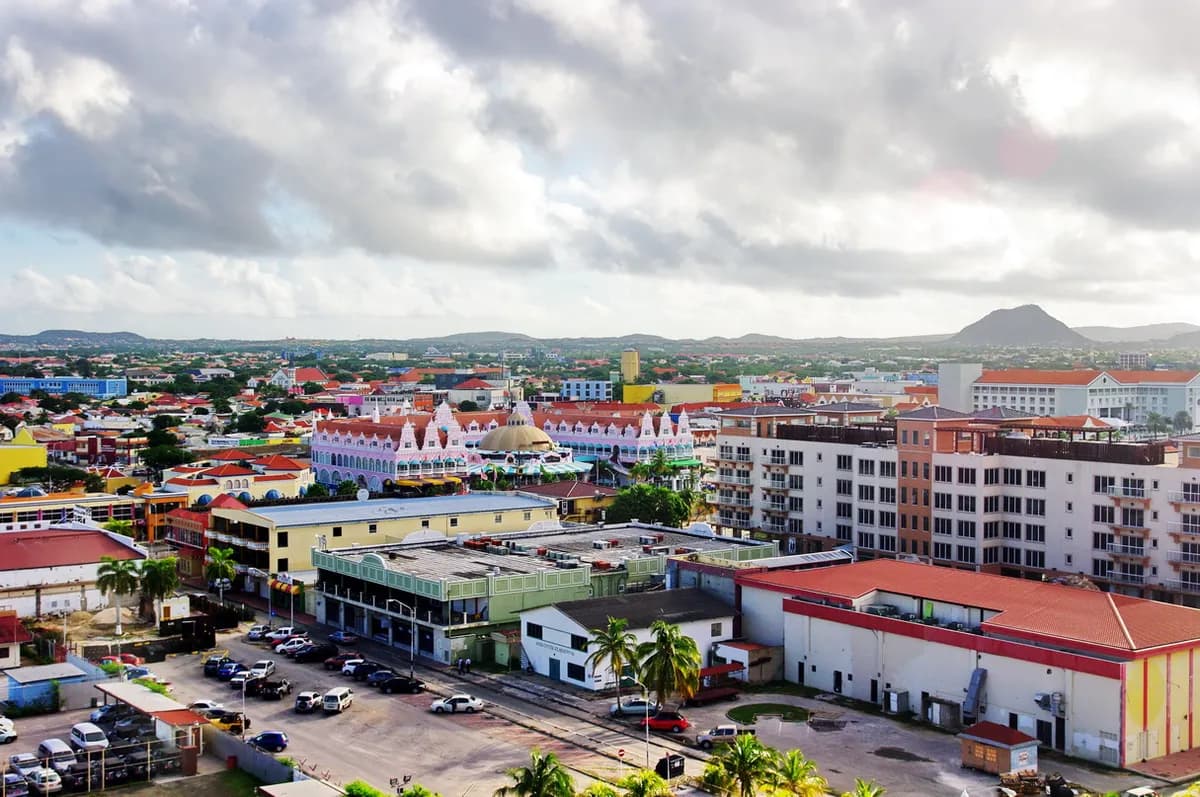
Aruba's cruise ships dock directly in downtown Oranjestad, and there is no tender boat involved: you walk off the ship into the terminal, with shops, restaurants, and the main street a five to ten minute walk away. That makes Aruba one of the more straightforward port days in the Caribbean, good for a downtown stroll, a bus or taxi run to the beach, or a booked shore excursion into the interior.
This guide covers what you need for a single port call: where the ship docks, what is walkable, how to reach Eagle Beach or Palm Beach and back on time, what a taxi or Arubus fare costs as of 2026, the shore excursions worth booking, and a backup plan if the weather turns.
Where ships dock in Oranjestad
Cruise ships dock at one of four docks on the northern side of downtown Oranjestad, Aruba's capital. The Aruba Ports Authority operates two air-conditioned cruise terminal buildings with staffed information booths that serve those docks. Aruba is a walk-off port, not a tender port: you disembark straight into the terminal and out onto the street, with no tender-boat wait and no weather-dependent shuttle to shore.
Inside, an ATM across from the visitor information booth dispenses both US dollars and Aruban florin, and a SETAR kiosk, the island's telecom provider, offers international calling and Wi-Fi cards. Which of the four docks your ship uses affects the walk slightly, but every dock puts you within a few minutes of the main road.
What is walkable from the terminal
Oranjestad is one of the more walkable cruise ports in the Caribbean, and most of what a first-time visitor wants (shopping, restaurants, historic sites) sits within easy reach of the pier. The walk from the dock to Lloyd G. Smith Boulevard, the main coastal road, takes about five to ten minutes depending on which of the four docks your ship uses. From there, Renaissance Marketplace is a short walk along the boulevard, and Havenstraat, Schelpstraat, and Main Street (Caya Betico Croes) run parallel to it, packed with jewelry stores, souvenir shops, cafes, and duty-free outlets.
The island's Main Bus Terminal, the hub for Arubus public buses, sits directly across the street from the cruise terminal. Aruba Tour Operators Association buses stage on the port premises itself, and independent tour operators and rental car desks operate just outside, so many shore excursion pickups happen within a couple of minutes of stepping off the ship.
If you would rather ride than walk, the free Arutram trolley loops a 1.9 km route through downtown on a fleet of four vehicles. Standard hours run roughly 10:00 AM to 4:00 PM, and on cruise ship days it runs two or three trolleys at once, with the week's schedule published every Monday. Check that schedule before counting on it, since service shifts with cruise traffic and the trolley can pause during rain.
Reaching the beaches from the cruise port
Oranjestad has no resort beach right at the terminal, but several good ones sit a short ride, or in one case a short walk, away.
| Beach | Distance from port | Best way to get there |
|---|---|---|
| Surfside Beach | About a 15-minute walk | On foot, the closest beach to the terminal |
| Eagle Beach | About a 10-minute drive | Taxi or Arubus |
| Palm Beach | Roughly 10 to 15 minutes by car, a little farther than Eagle Beach | Taxi or Arubus |
Surfside is the easy option if you would rather not deal with transport at all. Eagle Beach and Palm Beach both sit on the Arubus L10A line, which runs from Oranjestad up the northwest coast toward Malmok and Arashi, with L10A departures from Oranjestad roughly every 20 minutes on weekdays from early morning until about 6:10 PM, and hourly on Saturdays and Sundays from 6:00 AM to 6:00 PM; the return direction runs on its own timetable, so check the Arubus schedule for your day and your direction of travel. Build your return around your ship's departure with a comfortable margin: a taxi back takes the same 10 to 15 minutes, traffic allowing, but a bus means waiting for the next scheduled departure.
Bus, taxi, and getting around on a port day
Arubus public buses
The Main Bus Terminal across from the cruise terminal is the hub for Arubus, the island's public bus operator. A single one-way trip costs 2.60 USD, and an unlimited day pass costs 15.00 USD, which only pays for itself from about six one-way trips onward, especially since Arubus also sells a two-trip card for 5.00 USD; for a normal out-and-back beach run, single tickets cost less, and the day pass buys convenience rather than savings. The L10A line is the one most cruise passengers use, running from Oranjestad through the hotel strip to Malmok and Arashi.
Taxis: flat rates, no meters
Aruba taxis do not run on meters. Every fare is a fixed flat rate set by government regulation, based on the origin and destination zone. The rate system was overhauled by ministerial decree in 2026, effective May 20, 2026, the first comprehensive update since 2018, and the government now runs taxi.aw as the single official fare platform, with licensed taxis displaying a QR code linking to the calculator.
The minimum fare anywhere on the island is 10 USD. A flat 5 USD surcharge applies once per trip on Sundays, late nights 11 PM to 7 AM, the December 24 to January 1 holiday stretch, and official holidays; extra passengers beyond the first four cost 3 USD each, up to seven per vehicle. The 2026 sheet added the cruise terminal as an official fare origin, and cruise-day routes were already subject to government tariffs. As a rough guide, expect the terminal to Palm Beach in the low 30s in USD, to Eagle Beach a bit less, and to Surfside Beach less still, but confirm on taxi.aw or the driver's QR code before you agree to a fare. There is no Uber or Lyft in Aruba, since the regulated taxi system has no rideshare alternative; a taxi app such as ArubaTaxiApp is a dispatch tool for licensed taxis.
Rental cars for a single port day
Rental car desks operate just outside the terminal, and driving is on the right, same as the US. A car makes sense for a longer, self-guided loop, for example a stop at the California Lighthouse or a swing past the Natural Bridge. For a straightforward beach stop or downtown wander, a taxi or the bus is simpler.
Shore excursion options
Many Aruban tour operators offer pickup directly from the cruise port rather than only from hotels, cutting down on transfer-time risk. A few categories cover most of what cruise passengers book.
Jeep and off-road tours to the Natural Pool
The best-known option is a jeep-based safari to the Natural Pool inside Arikok National Park. De Palm Tours runs a four-hour morning departure listed as starting around 8:00 to 8:30 AM (95 USD adult, 85 USD child; confirm the exact pickup time for your date) and an afternoon departure from 1:15 PM to 4:15 PM (85 USD adult, 75 USD child); child pricing covers ages 6 to 9, the adult tier starts at age 10, and the minimum age is 6. Both include snorkel gear and round-trip hotel transportation and are rated strenuous. The morning departure adds stops at the California Lighthouse and the Baby Natural Bridge, while the afternoon departure passes the Ayo Rock Formation and the same bridge.
UTVs and ATVs are not permitted inside Arikok, so any UTV combo tour drives to the park entrance by UTV, then transfers riders into a jeep for the in-park portion. Booking independently, admission to Arikok is 22 USD per adult, with children under 17 free per the Aruba Conservation Foundation, which does not spell out the rate for a 17-year-old, so confirm that case at the entrance; the San Fuego entrance is open 8:00 AM to 3:30 PM and the Vader Piet entrance 8:30 AM to 3:00 PM. A fatal ATV accident on the island's rugged north coast in May 2026 renewed attention on off-road safety, reason enough to book an operator with an established safety record over the cheapest listing.
Catamaran and snorkel sail cruises
A snorkel and sail cruise suits travelers who would rather be on the water than in a jeep. These typically run roughly 65 to 100 USD per person and commonly include an open bar, a light lunch, and two to three snorkel stops, often the Antilla shipwreck paired with a reef spot such as Boca Catalina. Most operators pick up from hotels along the strip, and some coordinate with the cruise schedule directly, so ask about port pickup when you book.
De Palm Island
De Palm Island is a small private island off Aruba's southern coast, reached by a roughly five-minute ferry from its own pier near the airport and Balashi area, about a 20-minute drive from the cruise port. A day pass with round-trip bus transportation runs 129 USD for adults and teens aged 10 and up and 105 USD for children 3 to 9, free ages 0 to 2; walk-in rates without transport are 119 USD adult and teen and 95 USD child (operator rates as published in September 2026). The bundled transport is described as hotel pickup, so ask the operator whether it can collect you at the cruise terminal. It includes unlimited food and drink, twice-daily snorkel tours, banana boat rides, body-drop slides, and a kids' splash park. It is an all-day experience and walk-in sales close at 2:00 PM, so it suits a longer port day far better than a quick call.
Money and practical basics
The Aruban florin is pegged at 1.79 per US dollar, and US dollars are accepted almost everywhere, including at the terminal, so you do not need to change money before going ashore. Change is commonly given back in florin at a rate around 1.75 to 1.80 per dollar, and the terminal ATM dispenses both currencies. Some businesses decline US 50 and 100 dollar bills over counterfeiting concerns, so bring smaller denominations. A tourist SIM, eSIM, or Wi-Fi card is available at the airport, downtown, and from the SETAR kiosk inside the terminal.
Weather and wind on a port day
Aruba sits on the southern fringes of the Atlantic hurricane belt, and the Atlantic hurricane database records no direct hurricane hit on the island. Risk is low rather than zero: systems passing nearby, Hurricane Felix in 2007 among them, have brought heavy rain, gusty winds and rough seas, so watch the Departamento Meteorologico Aruba warnings and your cruise line's notices instead of assuming the call cannot be affected. The trade wind blows consistently, mostly from the east, with the strongest breezes generally running from around March through August and the calmest stretch falling late in the year; exact monthly averages differ between the Departamento Meteorologico Aruba normals and commercial reanalysis datasets, so treat any single figure as approximate. At the beach, anchor any umbrella firmly and keep loose items like hats and sarongs secured, since a stiff breeze is normal, not a warning sign. Rain is concentrated October through December and typically arrives as short, intermittent showers rather than all-day rain; the dry season runs roughly from February through June, with March and April the driest months in the official Departamento Meteorologico Aruba normals, and average annual rainfall is only about 18 inches, among the lowest in the Caribbean.
If the weather turns: indoor and covered options
On a rare wet or unusually windy day, downtown Oranjestad has enough covered ground to fill a port call. The Historical Museum of Aruba sits inside Fort Zoutman, built in 1798, with the adjoining Willem III Tower added in 1868, both a short walk from the port. Renaissance Mall and Renaissance Marketplace offer covered shopping and dining, and the downtown waterfront also has casino options. None of these require advance booking, an easy fallback if a shore excursion looks doubtful.
Timing your day around all aboard
Because Aruba is a walk-off port, your return is simpler than at tender ports: a walk, a short taxi ride, or a trolley ride back to the terminal, with no tender-boat wait to add uncertainty. Even so, check your cruise line's specific all-aboard time and the day's departure schedule before you head out, and build your itinerary backward from that number. If you are relying on Arubus for the return leg, remember it runs on a schedule, not on demand, so a taxi is the safer choice whenever your margin is tight.
San Nicolas and Baby Beach: possible, but a stretch
San Nicolas, home to Baby Beach and Aruba's best-known street art, sits about 11 miles (18 km) from Oranjestad, roughly a 20-minute drive from downtown, with the port itself a few minutes beyond that. A taxi each way runs well over 30 USD and eats a meaningful chunk of a single port day, so treat it as realistic only with a long call and comfort spending much of it in transit. For most cruise passengers it works better as a goal for a future, non-cruise trip, when a full day is available instead of a few hours.
Putting together your day
For a short call, keep it simple: the downtown shopping streets, Renaissance Marketplace, and lunch within a few minutes of the terminal, no transport required. For a half day, add a taxi or bus run out to the beach, timed with a buffer before all-aboard. For a full day, a shore excursion (a jeep run to the Natural Pool, a catamaran snorkel sail, or a day at De Palm Island) makes the most of the time, since operators generally handle the return timing for you. For a longer future trip, pair this guide with our first-timers guide and best beaches guide.
Frequently Asked Questions
How far is Eagle Beach from the cruise port?
Eagle Beach is about a ten-minute drive west of Oranjestad by taxi or public bus. It is close enough to fit into a half-day port call if you leave a comfortable buffer for the return trip, especially if you plan to take a taxi back rather than wait for a scheduled bus.
Do I need to book a shore excursion, or can I explore on my own?
Neither is required. Oranjestad is walkable directly from the terminal, so many passengers spend their whole call downtown with no tour booked. A taxi or the Arubus bus works well for the beaches. The Natural Pool is different: ordinary cars cannot reach it, so plan on a 4x4 tour, a horseback ride, or a long hike through Arikok. Wreck dives and snorkel trips run by boat, so book the dive or sail itself; many tour operators offer pickup right from the cruise port.
Is Oranjestad walkable from the cruise terminal?
Yes. The walk from the dock to Lloyd G. Smith Boulevard takes about five to ten minutes, and from there Renaissance Marketplace, Main Street, and several parallel shopping streets are all within easy walking distance. Oranjestad is considered one of the more walkable cruise ports in the Caribbean.
Do I need Aruban florin, or is US currency accepted?
US dollars are accepted almost everywhere on the island, including at the cruise terminal, so you do not need to exchange money before going ashore. Change is often given back in florin at a fixed rate, and a terminal ATM dispenses both currencies if you want some local cash. Bring smaller bills, since some businesses decline US 50 and 100 dollar notes.
Is there Uber or Lyft in Aruba?
No. Uber and Lyft do not operate in Aruba as of 2026, because the island runs a regulated government taxi system with fixed, published flat rates instead of metered or surge pricing. Any app marketed as an Aruba taxi app is a booking tool for licensed taxis, not a separate rideshare network.
How much does a taxi cost from the cruise port to the beach?
Aruba taxis use fixed flat rates rather than meters, updated in a 2026 rate overhaul that added the cruise terminal as an official fare origin. As a rough guide, expect roughly the low 30s in USD to Palm Beach and somewhat less to Eagle Beach or Surfside Beach, but always confirm the exact current rate on taxi.aw or the QR code displayed in the taxi before you ride.
What if it rains during my port day?
Rain in Aruba usually arrives as a short, intermittent shower rather than an all-day washout, and the rainy season runs from September through January. If the weather does turn, downtown Oranjestad has covered options within walking distance of the port, including the Historical Museum of Aruba at Fort Zoutman and the shops and restaurants at Renaissance Mall and Renaissance Marketplace.
Can I visit Baby Beach or San Nicolas on a cruise stop?
It is possible but a stretch. San Nicolas sits about 11 miles (18 km) from Oranjestad, roughly a 20-minute drive each way, and a taxi there and back runs well over 30 USD while consuming a large share of a typical port day. It works best with a long call and realistic expectations about how much time you will spend in transit rather than on the beach.
Facts on this page were last compared with their sources on . Details may have changed since. How we check
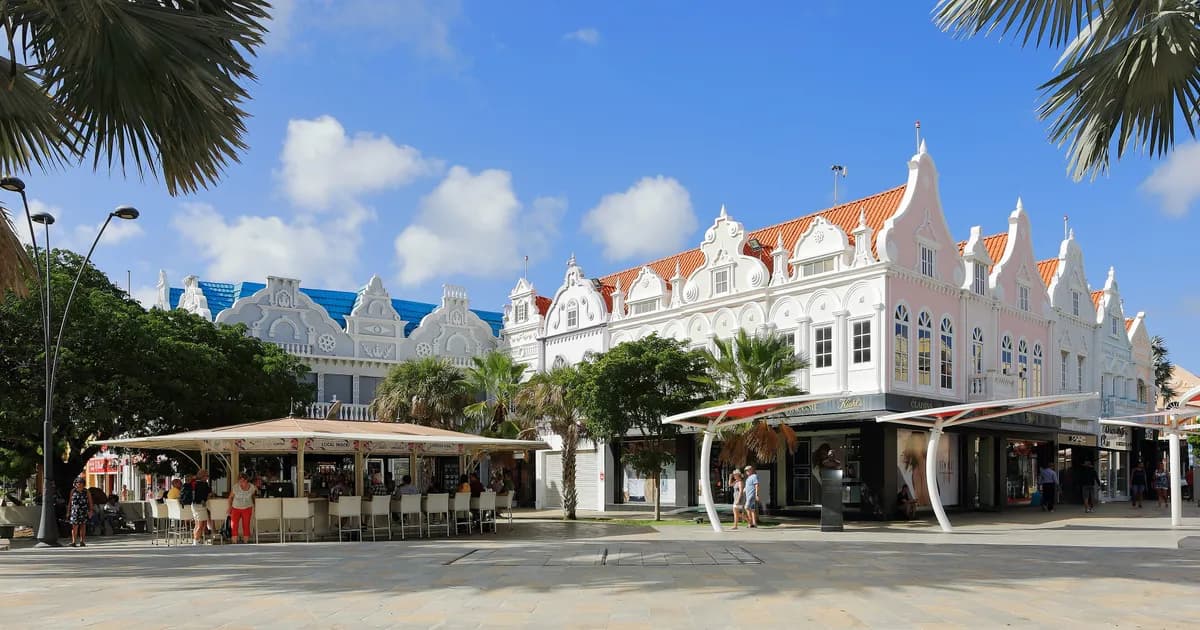
Oranjestad
This guide covers Oranjestad. Explore more about this destination.
View DestinationAbout the Author
Alex Borshch
Founder and editor of the Isla365 network. Spent six months living in the Dominican Republic over the 2013-14 winter, and has since wintered in Thailand, Vietnam and Turkey. Writes and edits the guides across the network.
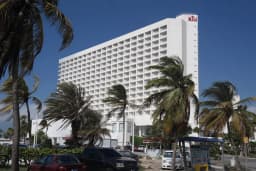
Photo gallery
Oranjestad viewed from the cruise port, Aruba
Photo: Bgabel via Wikimedia Commons · CC BY-SA 3.0 (https://creativecommons.org/licenses/by-sa/3.0)