Arikok National Park and the Natural Pool: A Full Guide
Arikok covers nearly a fifth of Aruba, and its centerpiece pool is off-limits to ordinary rental cars. Here's how to reach Conchi by jeep, horse, or hike, and what to skip when the surf is up.
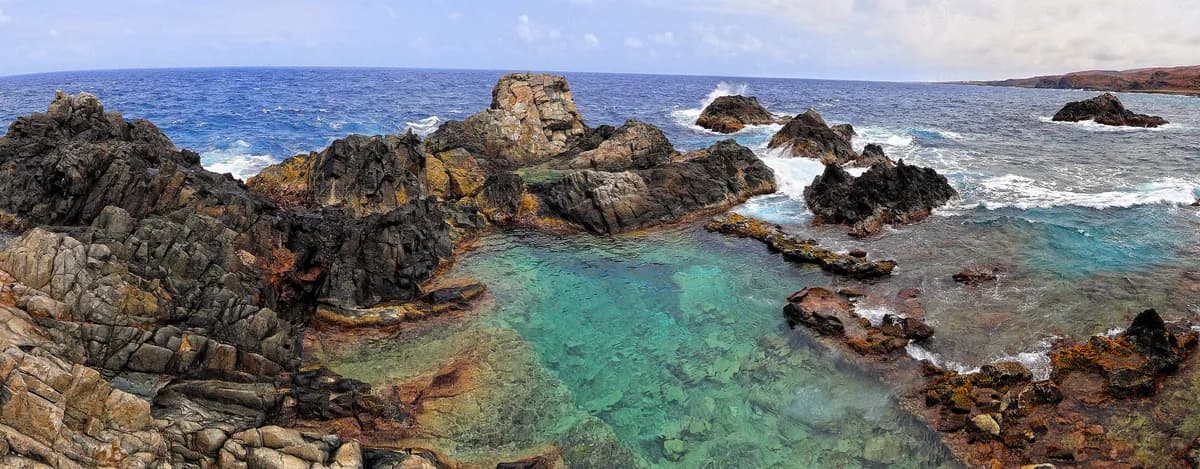
Arikok National Park covers roughly 32 to 34 square kilometers (7,907 acres) of Aruba's northeast, nearly a fifth of the island, and it looks nothing like the resort strip. Expect cactus desert, rugged hills, caves marked with Arawak rock paintings, and the Natural Pool (locally called Conchi), a rock-walled swimming hole on the wild windward coast that no ordinary rental car can reach. This guide covers fees, hours, and which access method fits your trip: 4x4 tour, horseback, or hike.
The short version: buy your Conservation Pass at the San Fuego visitor center, plan around an 8:00am to 3:30pm gate window, and pick one of three ways into Conchi: a guided jeep or UTV-to-jeep tour, a horseback excursion, or a hot multi-hour hike. Self-driving a standard rental car to the pool is not an option, and conditions at the pool itself can shut down swimming on any given day.
Arikok National Park: the basics
Arikok became an official national park in 2000, protecting a swath of Aruba's interior and northeast coastline that stands in sharp contrast to the beaches most visitors see first. Inside its roughly 32 to 34 square kilometers you'll find dry cactus scrubland, rocky hills, caves, and a coastline where heavy surf hits raw rock instead of a groomed shoreline.
As of 2026, the Aruba Conservation Foundation (ACF), which manages the park, charges $22 per adult for the Conservation Pass that covers entry. Children under 17 get in free. Residents of Aruba, Bonaire, and Curacao receive a discount with valid government-issued photo ID, though it's not automatically free entry, so bring ID and ask at the gate. If you see a price closer to $11 quoted on an older blog or forum post, ignore it: that's a stale figure from 2025 or earlier. Check the official ACF site for the current rate before you budget your day.
Entrances and hours
| Entrance | Location | Hours (daily) |
|---|---|---|
| San Fuego | Santa Cruz (main entrance and visitor center) | 8:00am to 3:30pm |
| Vader Piet | Southeast end of the park | 8:30am or 9:00am to 3:00pm; check with ACF before visiting |
San Fuego, near Santa Cruz, is the main entrance and home to the visitor center. Both gates stop admitting new visitors before mid-afternoon, so this isn't a park you casually wander into after a late lunch.
ATVs, UTVs, and motorbikes are prohibited throughout Arikok and all ACF-managed protected areas, a ban in force since June 1, 2020 (after a transitional period for registered operators ended October 31, 2020). This applies to tour vehicles too, which is why "UTV tours to the Natural Pool" work the way they do: operators drive guests to the park entrance on a UTV, then transfer everyone into a park-approved jeep with a guide for the run to Conchi. If a listing says "UTV to the Natural Pool," that jeep transfer is what's actually happening inside the park.
The Natural Pool (Conchi): what it actually is
The Natural Pool is a small ocean pool ringed by a wall of volcanic rock, tucked into a deserted stretch of Aruba's rugged windward northeast coast inside Arikok. Waves break over the outer rock wall and settle into a calmer, contained pocket of seawater, which is the whole appeal: an ocean swim without open-ocean surf, at least on a good day.
That qualifier matters. Swimming at Conchi is entirely condition-dependent. On rough days, park rangers advise against swimming altogether, and tour operators are upfront that snorkeling or swimming here is never guaranteed if the seas are up. This isn't hypothetical caution: the Aruba Conservation Foundation has closed Conchi "until further notice" before, including a closure driven by weather and water conditions from Hurricane Beryl. Check the ACF site or your tour operator the morning of your visit rather than assuming the pool will be swimmable just because it's on the itinerary. Snorkeling is the standard activity when conditions allow, and most operators, including ABC Tours and De Palm, include snorkel gear in the package price.
How to actually get there
This is the detail that trips up the most visitors: you cannot drive an ordinary rental car to the Natural Pool. The terrain beyond the park checkpoints is rough and rocky, and standard passenger cars aren't permitted past those points. Aruba.com's own guidance is blunt about it: inexperienced drivers should take a jeep safari rather than attempt to self-drive. You have three realistic options: a guided 4x4 or UTV-to-jeep tour, a horseback excursion, or a hike.
Because the Natural Pool sits inside Arikok, the $22 Conservation Pass is your only park entrance fee. Some tours, ABC Tours among them, explicitly state that park entrance is included in the price. Others don't spell it out. Confirm with your operator before you go, so you're not paying for the pass twice or assuming it's covered when it isn't.
Guided jeep and UTV tours: best for most visitors
This is the default choice for most people, and it's a well-established product on the island. ABC Tours runs jeep tours and UTV tours with the jeep transfer at the park gate, typically bundling snorkeling, cliff jumping, and a stop at an Indian cave, with lunch on morning departures. De Palm Tours offers a comparable "Natural Pool Off-Road Adventure," pairing the pool with a California off-road route in the morning or a ruins route in the afternoon, both including snorkel gear and hotel transportation. EZ Raider and Amstar run similar products, each removing the guesswork of driving rock terrain yourself.
Horseback riding
Rancho Daimari runs a roughly 3.5-hour horseback tour through the dunes and along the north coast that includes a swim stop at the Natural Pool, with departures around 9am and 2pm and hotel pickup included. It's a slower, quieter way to see this side of the island, scenic in a way a jeep convoy isn't, and the 9am departure means cooler temperatures for the ride out.
Hiking to Conchi
Two marked routes get you there on foot, and they are not the same hike. The main route runs from the Arikok Visitor Center at San Fuego: AllTrails lists the Conchi Natural Pool Trail at 6.6 miles round trip with about 1,587 feet of elevation gain, averaging roughly 3.5 hours, matching Aruba.com's estimate of a 3 to 4 hour round trip for experienced hikers.
A shorter alternative starts at Daimari: the Daimari to Conchi route is about 2.5 miles round trip with 321 feet of elevation gain, taking roughly 1 to 1.5 hours. The catch is that park tickets aren't sold at the Daimari trailhead, so buy your Conservation Pass in advance at the San Fuego visitor center before heading to Daimari.
Either way, come prepared. These trails are exposed with little to no shade, so you're in direct sun the entire hike. Carry at least one liter of water per person, wear sunscreen and sturdy shoes, and start early to beat the heat.
The caves: Fontein and Quadirikiri
Both caves sit on the park's windward side and are covered by your standard entrance ticket. Aruba.com lists them as open during park hours, though the gates stop admitting visitors earlier (3:30pm at San Fuego, 3:00pm at Vader Piet), so plan your cave visit before then.
Fontein Cave holds brownish-red pictographs painted on the ceiling by the Arawak (Caquetio) people, the island's indigenous inhabitants. It's the only cave on the island that still has Arawak drawings on its ceilings, alongside later graffiti left by early European settlers. Park rangers are often stationed nearby and can offer extra context at no additional cost.
Quadirikiri Cave is about 492 feet (150 meters) long, best known for two large dome-shaped chambers naturally lit by sunlight pouring through holes in the ceiling. It's also a nesting site for numerous small nocturnal bats, which are harmless to visitors.
Beaches in and around the park: know before you swim
This stretch of windward coast includes several named beaches, and it's worth knowing which are for swimming and which are for looking only.
Dos Playa is a pair of twin coves inside the park. Swimming isn't recommended for most visitors here: a strong undertow, unpredictable currents, and powerful waves make it better suited to photos and beachcombing. Reaching it means navigating unpaved park roads, and a four-wheel-drive vehicle is highly recommended, especially after rain; hiking in is also an option.
Boca Prins is a striking bay inside the park named after the former Prins plantation, backed by white sand dunes against a rocky shoreline. Wooden stairs lead down to the beach, and the nearby Boca Prins Restaurant offers refreshments. Posted signage strongly advises against entering the water: the undertow is very strong and always present. A marked route runs from Boca Prins to Dos Playa, about 4.2 miles with roughly 708 feet of elevation gain and 2 to 2.5 hours, starting from the Vader Piet side and passing Fontein Cave; trail markings are sporadic and shade is minimal.
Daimari Beach, at the park's north end, is a secluded, crescent-shaped beach of roughly 200 feet with soft white sand. It's not generally considered a good swimming beach, with riptides among its typical conditions; its main value for most visitors is as the trailhead for the shorter hike to the Natural Pool.
Andicuri Beach lies a little further up the windward coast, just south of the collapsed Natural Bridge, a sandy cove framed by dramatic coral-stone bluffs. Its consistently stronger surf hosts local bodyboarding competitions, but only experienced swimmers should get in the water, with real awareness of the currents. The beach is reached via a dirt road, there's no food or beverage service (bring your own picnic), and driving or barbecuing on the sand isn't allowed.
The Natural Bridge and Baby Bridge
Aruba's original Natural Bridge, between the Bushiribana gold mine ruins and Andicuri Beach, collapsed suddenly on September 2, 2005. At about 30 meters long and 7.6 meters high, it had been the largest bridge of its kind in the Caribbean. The remains are still worth a stop, and the adjacent, intact "Baby Bridge" shows what the original looked like before the collapse. Both formed over thousands of years as pounding waves and strong winds wore away at the coral limestone cliffs along the north coast.
Which access option fits you
For visitors short on time, unsure about off-road driving, or traveling with people who'd rather not hike in the sun, the guided jeep or UTV-to-jeep tour is the pick. It removes the most risk and typically bundles park entry, snorkel gear, and sometimes lunch into one price.
If you ride, the horseback trip through the dunes trades speed for scenery and still gets you a swim stop at Conchi. If you're a fit, prepared hiker who wants to go independently, the choice comes down to time: the full San Fuego route is a real 3 to 4 hour undertaking, while the Daimari shortcut is a far shorter walk, provided you've already bought your ticket at San Fuego.
Whichever option you choose, don't build your day entirely around swimming at Conchi. Treat the pool as a bonus, follow whatever ranger advisories are posted that day, and have a backup plan: the caves, the Natural Bridge remains, or the drive itself through a side of Aruba most beachgoers never see. For more on logistics, see our guide to getting around Aruba, and browse our full list of attractions and activities to round out your itinerary.
Facts on this page were last compared with their sources on . Details may have changed since. How we check
About the author
Alex Borshch
Get On The Newsletter Waitlist
The Aruba 365 newsletter has not launched yet. Leave your email to be told when it does. No mail app required.