Baby Beach and San Nicolas Street Art: An Aruba Day Trip
Baby Beach's shallow lagoon is the payoff at the end of the drive south, and San Nicolas traded refinery smokestacks for murals worth walking on the way.
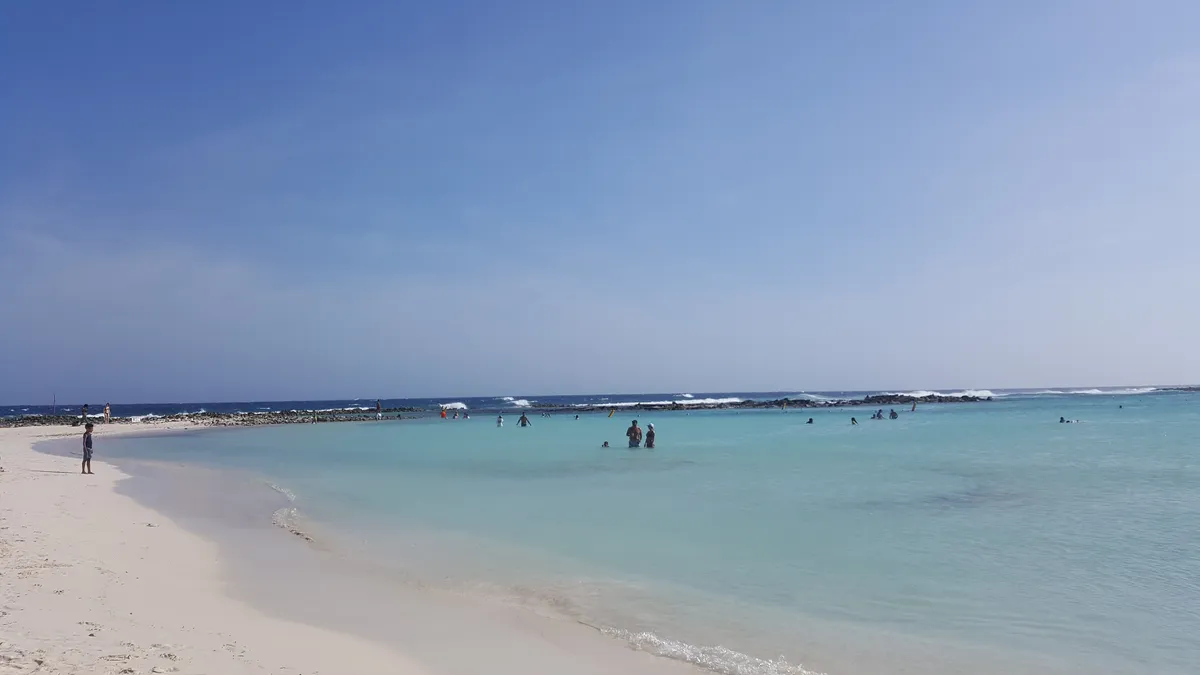
San Nicolas sits about 19 km (12 mi) southeast of Oranjestad, roughly a 21-minute drive between the two city centers; Aruba's tourism site calls it around 30 minutes, and the Palm Beach hotel zone adds a little more. It's where you go for two things the high-rise zone doesn't have: wall-to-wall street murals and a shallow, calm swimming lagoon called Baby Beach. Aruba's second-largest town owes its street-art reputation to the Aruba Art Fair, which has filled Main Street with large-scale murals over successive editions.
This guide covers the murals, Charlie's Bar (open since 1941), where to eat, and the refinery history that shaped the town, including the late-2025 announcement that ended its refinery era for good. San Nicolas is a working town first and a tourist stop second, and that's exactly why it's worth the drive.
Why San Nicolas looks and feels different
San Nicolas earned the nickname "Sunrise City" because it sits at the island's eastern, sunrise-facing end, and locals have also called it "Chocolate City," a reference to its largely Afro-Caribbean community. Neither nickname is marketing. Both come from a history built on oil, not tourism.
In 1924, Captain Robert Rodgers, a Scottish agent for the Lago Petroleum Company, identified San Nicolas harbor as a transshipment point for Venezuelan crude from Maracaibo. A transshipment port opened in November 1927, and the Lago refinery followed, under construction from 1928 with first units running by January 1, 1929. At its post-World War II peak, Lago employed more than 10,000 people, about 1,000 foreign supervisory staff and the rest native Arubans and workers recruited from the British West Indies, mainly Trinidad, Jamaica, and British Guyana, and it was one of the most important fuel suppliers to the Allied forces during the war.
That immigration wave made San Nicolas Aruba's carnival heartland. Caribbean-English workers brought a Trinidadian style of carnival with them and organized the Allied-victory parade in town; Aruba's first public island-wide Carnival followed in 1955. Calypso and road march music arrived the same way. Today's Caiso & Soca Monarch contest, crowning the season's Road March King or Queen, is still held at Carnival Village in San Nicolas, built on reclaimed refinery land.
Exxon closed its refinery in March 1985; Coastal later reopened it. On November 8, 2025, Aruba and the Netherlands announced the definitive end of oil refining at the site, with €50 million in Dutch funding for strengthening and modernizing the electricity grid and sustainable energy infrastructure, closing roughly a century of refinery history. The old plant still stands near the island's southeastern beaches and can be seen from Rodgers Beach, a genuine industrial ruin rather than a themed backdrop.
The street art: what it is and how to see it
Forbes called San Nicolas "the street art capital of the Caribbean" in 2019, and the murals are the main reason day-trippers make the drive now. They cover walls and buildings along and around Main Street, created mainly through successive editions of the Aruba Art Fair. One of the best-known pieces, "Caribbean King & Queen" by Colombian artist Guache, went up in 2016.
Viewing the murals is free and self-guided: walk Main Street and the surrounding streets at your own pace, no ticket, no set path. Guided Aruba Mural Tours are available for more context on the artists.
The 2026 Aruba Art Fair, its ninth edition, was scheduled for September 11-13 at the Promenade under the theme "Nature x Mankind," with more than 100 local and international artists. Organizer Tito Bolivar of ArtisA, with curator Renwick Heronimo, had also scheduled an ARTTABLE opening event on September 7 at 7 p.m. in front of ArtisA Gallery, and a guided Sunday Mural Tour on September 13 at 5 p.m. from the same gallery.
Outside fair season, San Nicolas runs the Carubbian Festival, relaunched in 2026 as a monthly event at Carnival Village held every last Thursday through November: local vendors, food, drinks, handmade products, performances, DJs, and live music, a family event that doubles as revitalization for the town. The third 2026 edition landed June 25 with a World Cup theme; the next was scheduled for July 30, 2026.
Two small museums round out the culture stop. The Museum of Industry occupies the Art Deco San Nicolas Water Tower, built in 1939 and designed by Pieter van Stuivenberg; the museum opened inside it in 2016 and covers Aruba's industrial layers: gold, aloe, phosphate, oil, and tourism. Open Monday through Friday 9 a.m. to 6 p.m. and Saturday 10 a.m. to 2 p.m., closed Sunday, admission USD 5. Nearby, the San Nicolas Community Museum, in the historic Nicolaas Store building, displays donated memorabilia of everyday community life, on the same hours.
Baby Beach: the shallow lagoon families drive for
Baby Beach is officially named Klein Lagoen, a shallow, sheltered, man-altered lagoon near Seroe Colorado at Aruba's southeastern tip. It's about a 45-minute drive from the Palm Beach hotels, per Aruba's official tourism site, so pairing it with San Nicolas makes sense.
The interior water is generally waist-high and calm enough for very small children, which is the whole draw. But it deepens toward the inlet where the lagoon meets the open ocean, and beyond the breakwater the currents turn genuinely dangerous. There have been numerous drownings over the years, including strong swimmers, and there are no lifeguards on duty. Official guidance is to stay within the marked snorkel area near where the bay opens to the ocean.
Despite sitting close to the old refinery, the water stays clean and clear because of how local currents run. Amenities include a refreshment stand, Big Mama's Grill for barbecue and seafood platters, rentals for beach beds, windscreens, and snorkel gear, complimentary sun-shade huts, a local dive shop, public bathrooms, and public transport access. A leftover from the Lago Colony era sits here too: the Aruba Esso Club, built in the 1950s with a restaurant, dance floor, and baseball stadium. Today only one large abandoned building remains, though the dive shop still operates nearby.
Rodgers Beach, locally known as Nanki, is a narrow, powdery-white cove about a one-minute drive from Baby Beach, with colorful fishing boats anchored in its protected bay, popular with local families on weekends and quiet on weekdays, a good backup if Baby Beach feels crowded. It's named for Captain Rodgers, and the old refinery is visible from the beach. Amenities include public parking, public transport access, an adjacent dive shop with gear rentals, a shower, and a restaurant.
| Spot | What it's for | Drive time | Best for |
|---|---|---|---|
| San Nicolas Main Street | Murals, self-guided walk | About 30 minutes from Oranjestad | Photography, culture, street art |
| Baby Beach | Shallow swimming lagoon | About 45 minutes from Palm Beach hotels | Small children, calm water, marked snorkel area |
| Rodgers Beach | Quiet cove, fishing boats | One minute past Baby Beach | Weekday quiet, avoiding crowds |
Where to eat
Charlie's Bar is the stop nearly every visitor makes. Charles "Charlie" Brouns and his wife opened it on September 18, 1941, originally serving merchant marines, dock workers, and refinery workers. As of 2026 it's still run by the third generation, Charlie Brouns III and his sister Montsy, and it celebrated 80 years in 2021. The walls are packed floor-to-ceiling with decades of donated patron memorabilia: license plates, cameras, stuffed animals, pennants, flags, old driver's licenses. The menu specializes in seafood and Creole plates sourced through the owner's network of local fishermen, plus non-seafood options like New Zealand lamb chops. Hours: 11:30 a.m. to 6:00 p.m., closed Sundays, at B v/d Veen Zeppenfeldstraat #56.
O'Niel Caribbean Kitchen, chef-owned by Oneil Williams, sits in the San Nicolas Art Walk at Bernard van de Veen Zeppenfeldstraat 15. The menu leans Jamaican-Caribbean (oxtail stew, jerk chicken, ackee with saltfish) alongside Aruban dishes like balchi, fried fish balls. It carries a 4.6 rating on Tripadvisor from roughly 490 reviews, though reviewers note slow service, and the oxtail can run out on busy nights. Closed Mondays; hours run roughly noon to 8 p.m. Tuesday-Thursday and Saturday, noon to 8 p.m. Friday, and 11 a.m. to 5 p.m. Sunday, worth confirming before you drive out.
Kamini's Kitchen, at De Vuyst 41B, is family-run by chef-owner Kamini Kurvink, who blends Trinidadian heritage with Aruban flavors. Its specialty is roti filled with curry goat, chicken, shrimp, duck, or conch, and its fried red snapper with Creole sauce is another signature. It holds a 4.7 rating on Tripadvisor across more than 1,700 reviews. Closed Tuesdays, open Wednesday-Monday from 11 a.m. to roughly 7:30 p.m.
On the way to or from San Nicolas, Zeerovers in Savaneta is worth the detour: a casual eatery on a working fishermen's wharf in Aruba's first capital, where the day's catch is cleaned and cooked in front of you and served finger-food style in baskets. The menu is deliberately simple, one or two daily catches plus sides like fried plantain, french fries, pan bati, and onions in vinegar. Cash only, kitchen hours 11 a.m. to 9 p.m., closed Mondays, at Savaneta 302. "Zeerover" is Dutch for "pirate."
What San Nicolas still is, and isn't
San Nicolas is not a resort extension of Palm Beach, and it isn't trying to be. Its 2010 census population was 15,283, dropping to about 14,175 by 2020, and the community remains largely descended from British Caribbean and wider Caribbean immigrants who came for refinery jobs starting in the 1920s. That history stays visible in the food, the carnival tradition, and the calypso roots running through the town's music, none of it staged for visitors. For crafts rather than murals, Cosecha formerly ran a store and creative centre here (a sister to its original Oranjestad shop) selling Aruban work certified under the national Seyo Nacional pa Artesania seal, issued since 2012, plus hands-on workshops like mosaic-making.
What's changing is the town's relationship to the refinery that built it. With the site's dismantling and repurposing confirmed as of November 2025, San Nicolas is in active transition from company town to arts and culture destination, a shift the murals and the Carubbian Festival are already ahead of. Public buses run several times an hour if you'd rather skip the rental car, though driving lets you link San Nicolas, Baby Beach, and Rodgers Beach into one loop.
Planning the day
Walk Main Street in the morning before the heat builds, stopping at the Museum of Industry or Community Museum for context. Have lunch at O'Niel's in the Art Walk area or at Kamini's near Seroe Colorado, or at Charlie's Bar any day except Sunday or national holidays, arriving before it closes at 6 p.m. Then drive to Baby Beach and Rodgers Beach for the afternoon: swim the marked, protected water at Baby Beach, and if it's crowded, drive one minute to Rodgers for quieter sand. A route back through Savaneta lets you close with Zeerovers.
This corner of the island rewards realistic expectations. It isn't manicured, and sights like the old Esso Club ruin at Baby Beach or the refinery skyline from Rodgers Beach are genuinely industrial rather than picturesque. For more outside the hotel strip, see the San Nicolas destination guide, or browse Aruba destinations and beaches. Pairing this day with a hike through Arikok National Park covers both ends of Aruba's less-obvious side.
Facts on this page were last compared with their sources on . Details may have changed since. How we check
About the author
Alex Borshch
Get On The Newsletter Waitlist
The Aruba 365 newsletter has not launched yet. Leave your email to be told when it does. No mail app required.